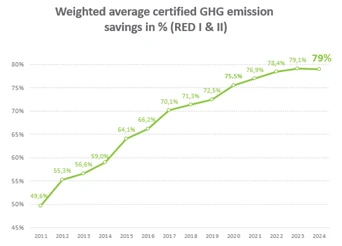
Renewable ethanol produced in the EU delivers an average of 79% fewer greenhouse gas (GHG) emissions compared to fossil petrol. This figure is not speculative — it is based on certified life cycle data compiled and published by ePURE, the European Renewable Ethanol Association.
Put simply, EU ethanol isn’t just a greener option — it’s a fully verifiable solution already contributing significantly to transport decarbonisation.
What does this emissions reduction include?
The 79% figure comes from a full well-to-wheel analysis, meaning it accounts for:
-
The cultivation of feedstocks (e.g. corn, wheat, sugar beet);
-
Energy used in fermentation and distillation;
-
Transportation and distribution;
-
Tailpipe emissions when burned in the engine.
It also reflects credits for co-products like high-protein animal feed (DDGS) and captured biogenic CO₂, which displace more carbon-intensive alternatives in the market.
According to ePURE’s 2024 annual statistics, many EU ethanol facilities already surpass 90% GHG savings, demonstrating what’s possible with best-in-class technology and practices.
What's behind these results?
This performance is driven by a combination of innovation, efficiency, and sustainability. In 2024:
-
96% of all feedstocks used for ethanol in the EU were certified as sustainable;
-
Most production plants operated on renewable or highly efficient energy, including cogeneration systems;
-
Ethanol production co-generated over 6.5 million tonnes of animal feed and 1.5 million tonnes of CO₂, replacing fossil-based alternatives.
Ethanol’s role in the EU Green Deal
As Europe moves toward climate neutrality by 2050, transport remains one of the most difficult sectors to decarbonise. Renewable ethanol is one of the few scalable, available and proven solutions that can reduce emissions immediately, especially in areas where full electrification is not feasible.
It plays a key role in:
-
Light-duty vehicles already on the road, through E10 and E85 petrol blends;
-
Agricultural and off-road machinery, where electric alternatives are limited;
-
Rail transport in rural areas, where electrification infrastructure is lacking.
Ethanol vs biodiesel: which is cleaner?
Although both are renewable fuels, ethanol often holds the upper hand in terms of climate performance:
-
Biodiesel tends to have higher embedded emissions, especially when derived from imported oils;
-
Ethanol combustion produces lower NOx and particulate matter, improving air quality;
-
Ethanol co-production with feed reduces land-use pressure, contributing to a circular, dual-output value chain.
Impact on agriculture and rural economies
Ethanol production benefits local economies in several ways:
-
It provides a reliable market for surplus grain;
-
It creates stable jobs in rural regions;
-
It supports the development of the bio-based economy, with downstream uses for ethanol, CO₂, and protein-rich byproducts.
These advantages go beyond environmental metrics, fostering economic resilience and food-energy synergies in EU agriculture.
Can the GHG performance improve even further?
Yes — and some producers already lead the way. Next-generation technologies include:
-
Second-generation (2G) ethanol from crop residues and waste biomass;
-
Carbon capture and utilisation (CCU) at fermentation sites;
-
Anaerobic digestion of process residues, which feeds back into plant energy needs.
These innovations point toward GHG savings well above the current average and offer a strong case for supporting low-carbon liquid fuels in parallel with electrification.
Source: ePURE